Concept
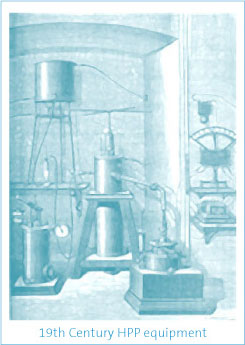
Historically the food industry has focused its efforts on developing innovative applications that allow more natural, fresher and safer products to be launched into the market; in short, higher-value food items. For this reason, one of the most successful and widely-employed developments so far this century, has been High Pressure Processing (HPP). A technique that submits packaged food products to high isostatic pressures (i.e., a uniform pressure applied to the entire surface of the product) of up to 6000 bars. The pressure is transmitted by water for a few minutes in side of a steel vessel.
Unprocessed product – loading of product – filling of vessel – low pressure – water tank – high pressure – pressurisation – high pressure – unloading of product – processed product The ‘non-thermal pasteurisation effect’ of high pressure on food has been known since the late twentieth century. It was in Japan, in the 1990s, when the first industrial applications for food were developed. Even so, it was not until 2000 that high pressure processing began to be used for almost all foodstuffs. Thereafter, it became a real and effective alternative to traditional heat treatments (pasteurisation and sterilisation).